Four panels for 470 animals:
solar watering on mountain pasture
In the Béarn Pyrenees, a pastoral association moves 470 animals up to its mountain pasture every summer. The captured spring flows at the bottom of the valley; the drinking troughs are 45 metres higher, on the plateau where the herd grazes. No power line, no track: everything that goes up must be light. Here is how this livestock watering system is sized in LE LAB, the solar pumping sizing application, from the herd to the pump curves, with real screenshots and figures.
The need, as the shepherd lives it
Every summer, the association's herd leaves the barns for the high-altitude grass. Water is not lacking at the spring, lower down; it is lacking where the animals graze. In dry summers, hauling water becomes a daily chore: go down, fill up, come back up. The goal fits in one sentence: let the spring fill the water trailer and the troughs on the plateau by itself, at the pace of the sun.
A generator would mean hauling fuel up all summer. Fully solar pumping, without batteries, is built for situations like this: a few panels, a 3.5-inch pump, and no one left to send up there with jerrycans.
The need calculated from the herd
No volume to guess: LE LAB asks for the herd, not cubic metres. 60 cattle, 10 horses, 400 small ruminants, on FAO figures per animal per day, and the application calculates: 4.7 m³ per day. Seasonality is declared in the same place: pumping runs from June to September, and the entire study is aligned with the pasture season.
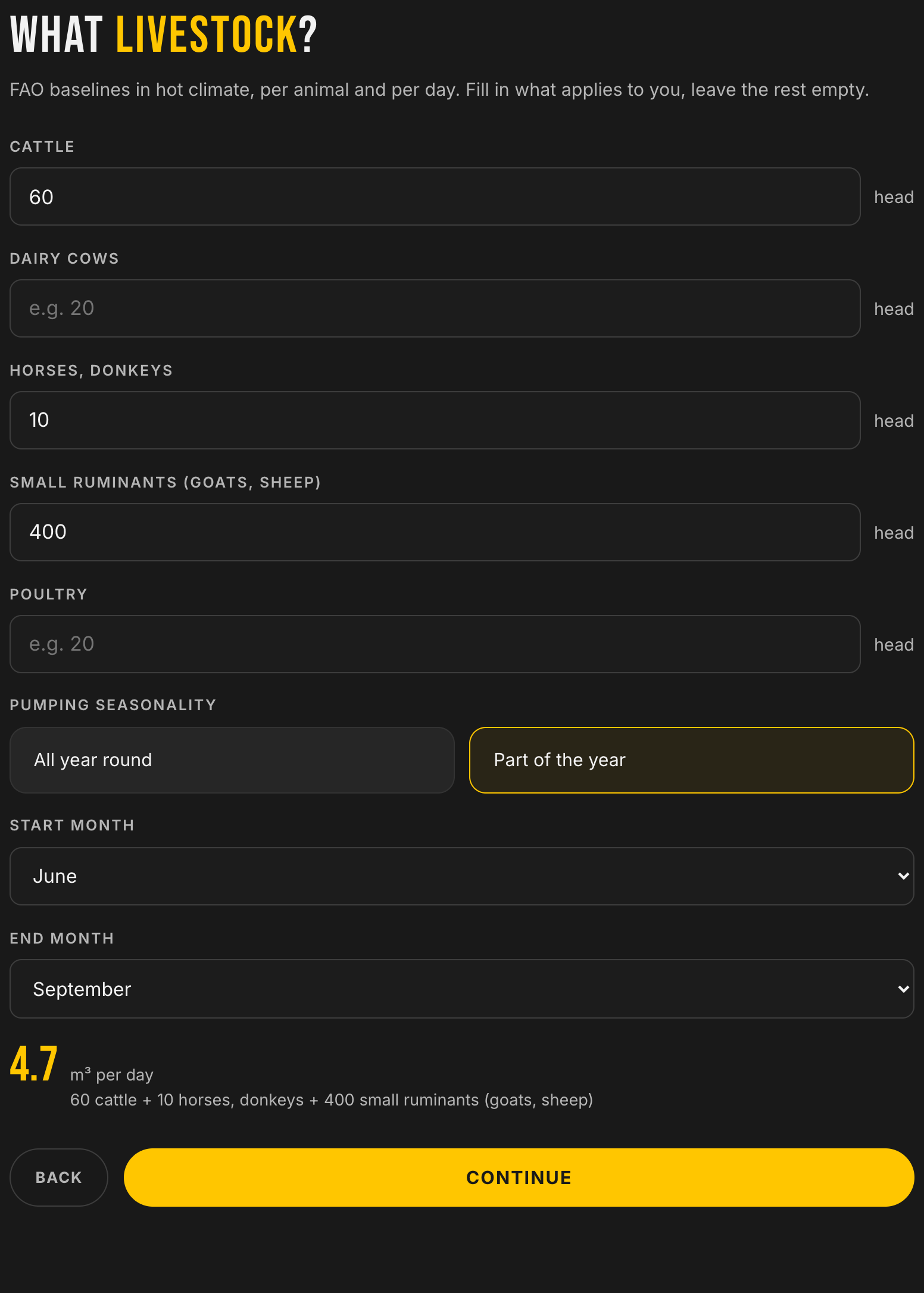
The herd step: you enter head counts, the application calculates cubic metres, and the season is declared with one click.
The site data
The solar reference city is Pau, at the foot of the Béarn valleys. The pump is immersed 3 m deep in the intake basin; a 45 m delivery head to the troughs, 300 m of pipe along the slope: the total head is calculated automatically, 51 m. No backup power possible up there, and the 10 m³ trailer is declared as the existing reserve.
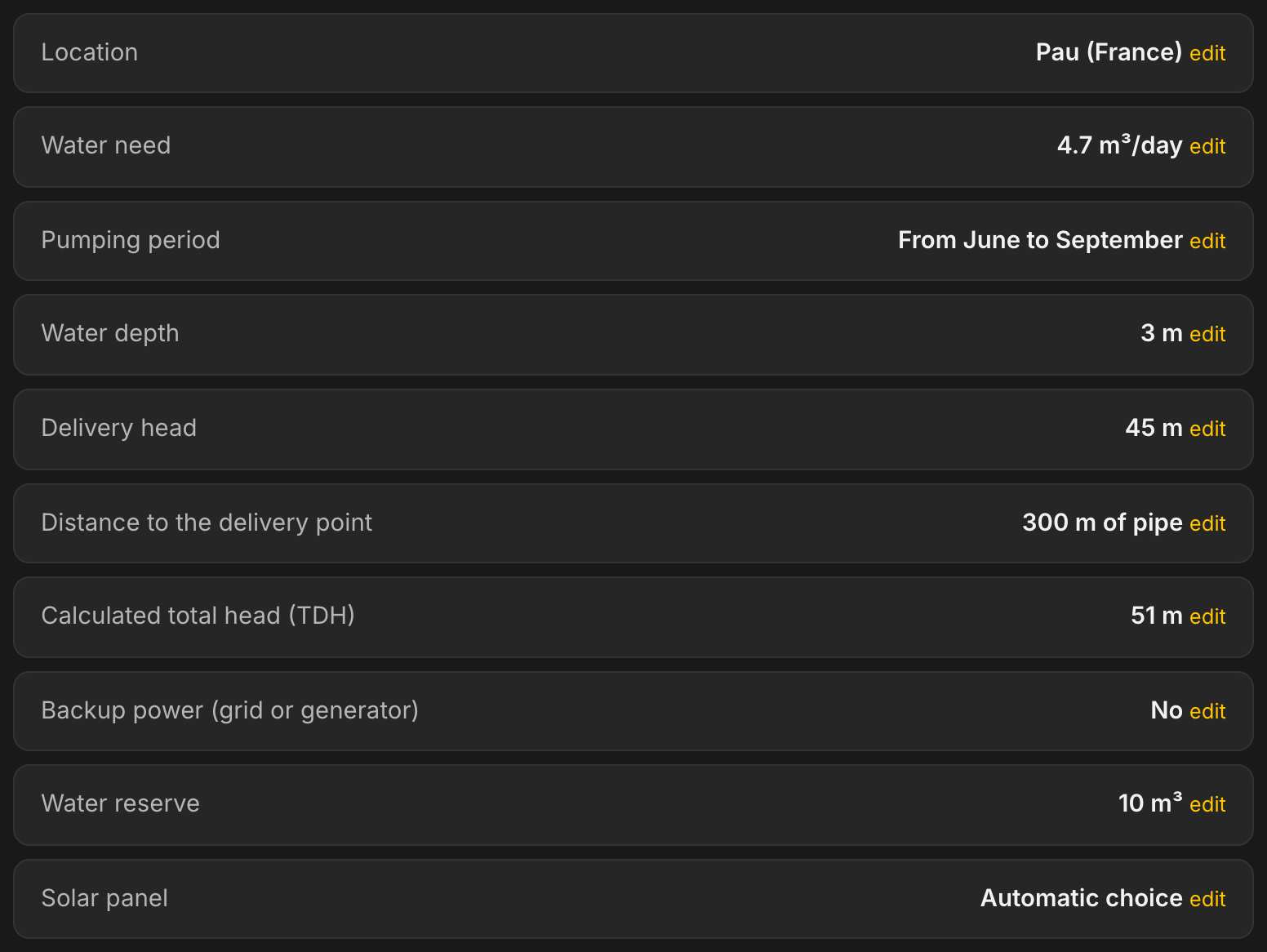
The summary before calculation: nine answers are enough, the total dynamic head is calculated for you.
What LE LAB proposes: the smallest system in the series
A LORENTZ PS2-150 AHR-04S, a 3.5-inch helical rotor pump, powered by four 95 W panels in two strings of two, for 380 Wp at 24 V. The whole system, pump, controller and panels, can be carried up on foot. Production over the season: 5.1 to 5.4 m³ per day for 4.7 required. At the other end of our case study series, the hybrid system in Chad runs to 11,700 Wp, thirty times more: the same application sizes both.
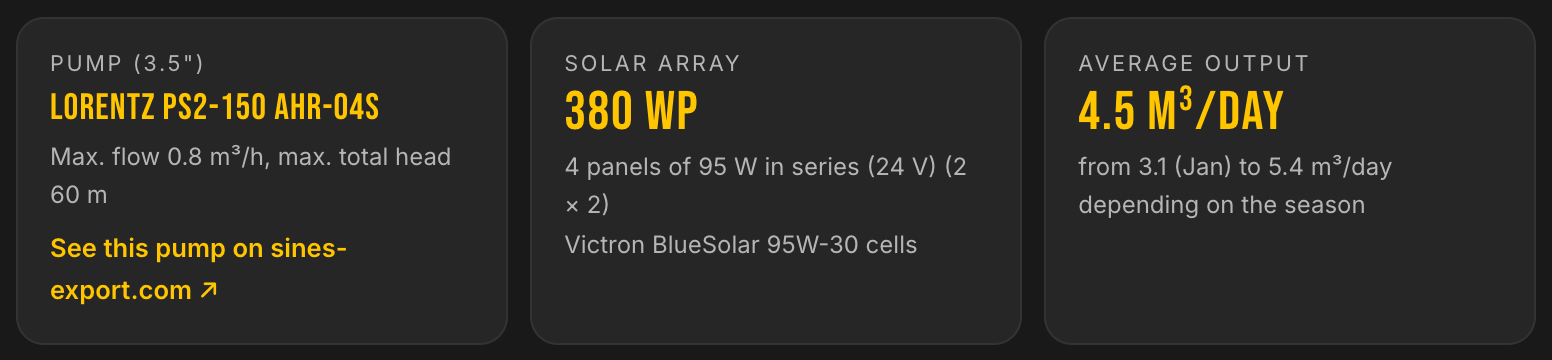
The solution at a glance: pump, solar array and average production.
Production, aligned with the pasture season
Over sixteen years of the Pyrenean foothills' real solar data, all four pasture months stay above the need line: 5.3 m³ per day in June and July, 5.4 in August, 5.1 in September, the critical month shown. The winter months appear in red, and that is exactly right: the herd has come back down, the study is sized for the declared period, not for a January with no animals.
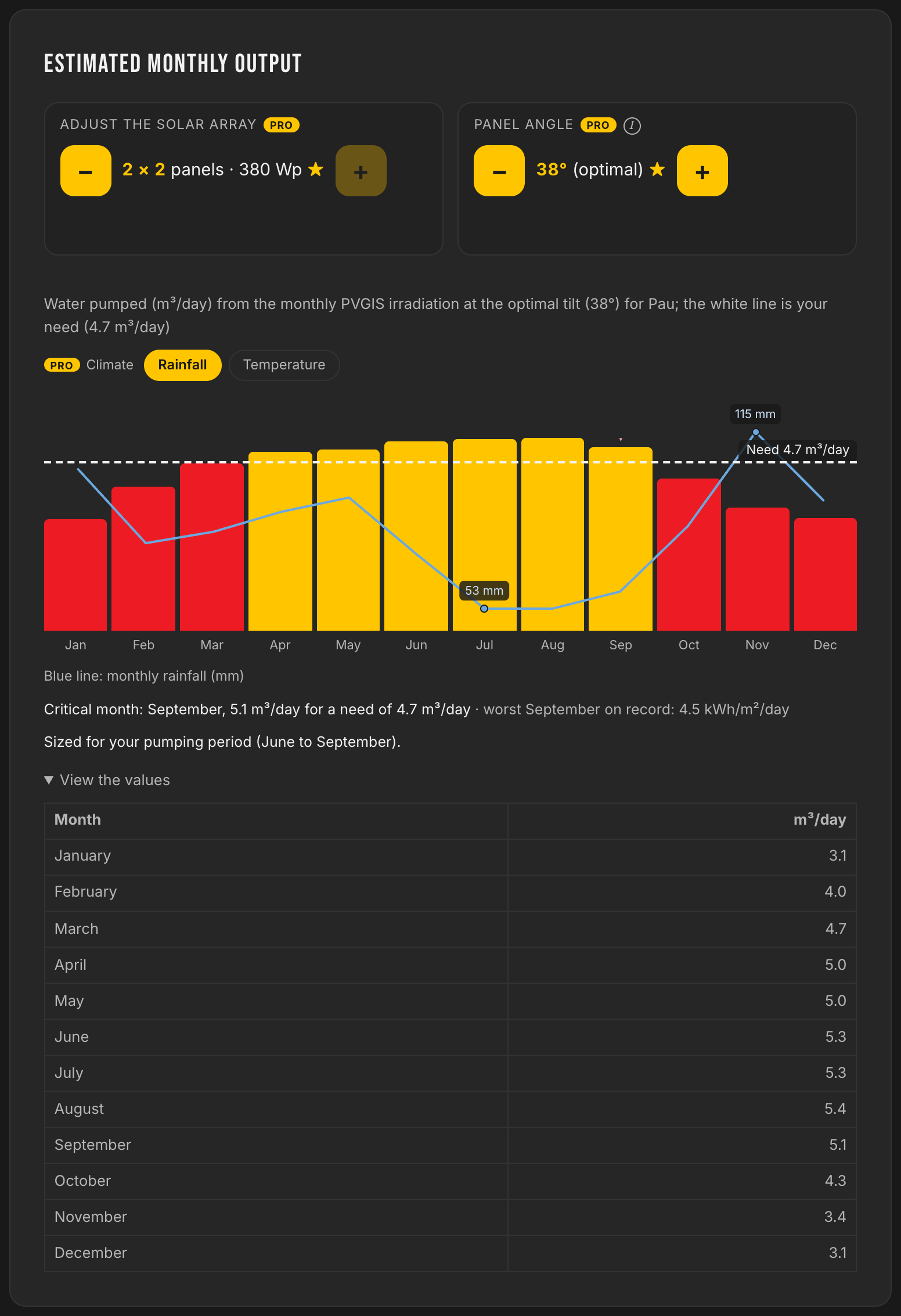
Sized for the pumping period: the reference month is September, the tightest of the season, not an irrelevant winter month.
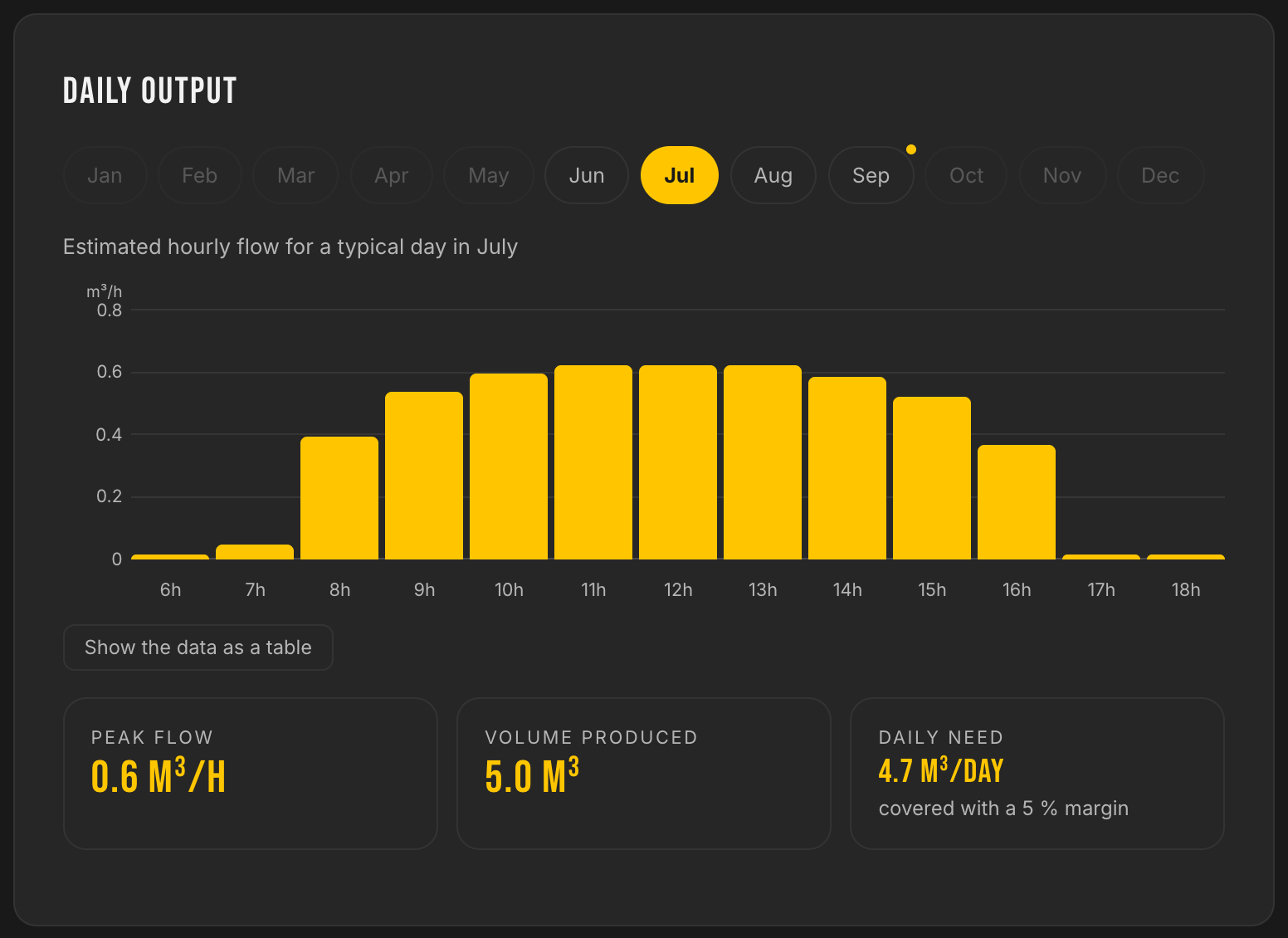
The typical July day: a plateau at 0.6 m³/h from 9 am to 3 pm, 5.0 m³ lifted to the troughs. While the herd grazes, the trailer fills.
The 10 m³ trailer put to the test
LE LAB simulates the water reserve day by day, over the sixteen pasture seasons of sixteen years of real weather. With the 10 m³ trailer, 118 of the season's 122 days are fully covered. The 4 incomplete days of an average season still deliver 71% of the need, and the shortfall comes to just 6 m³ out of 573, or 1%. The worst episode shows the mountain's real risk: fifteen days of low sun from 6 to 20 June 2010, a gloomy start to the pasture season as Béarn can sometimes produce.
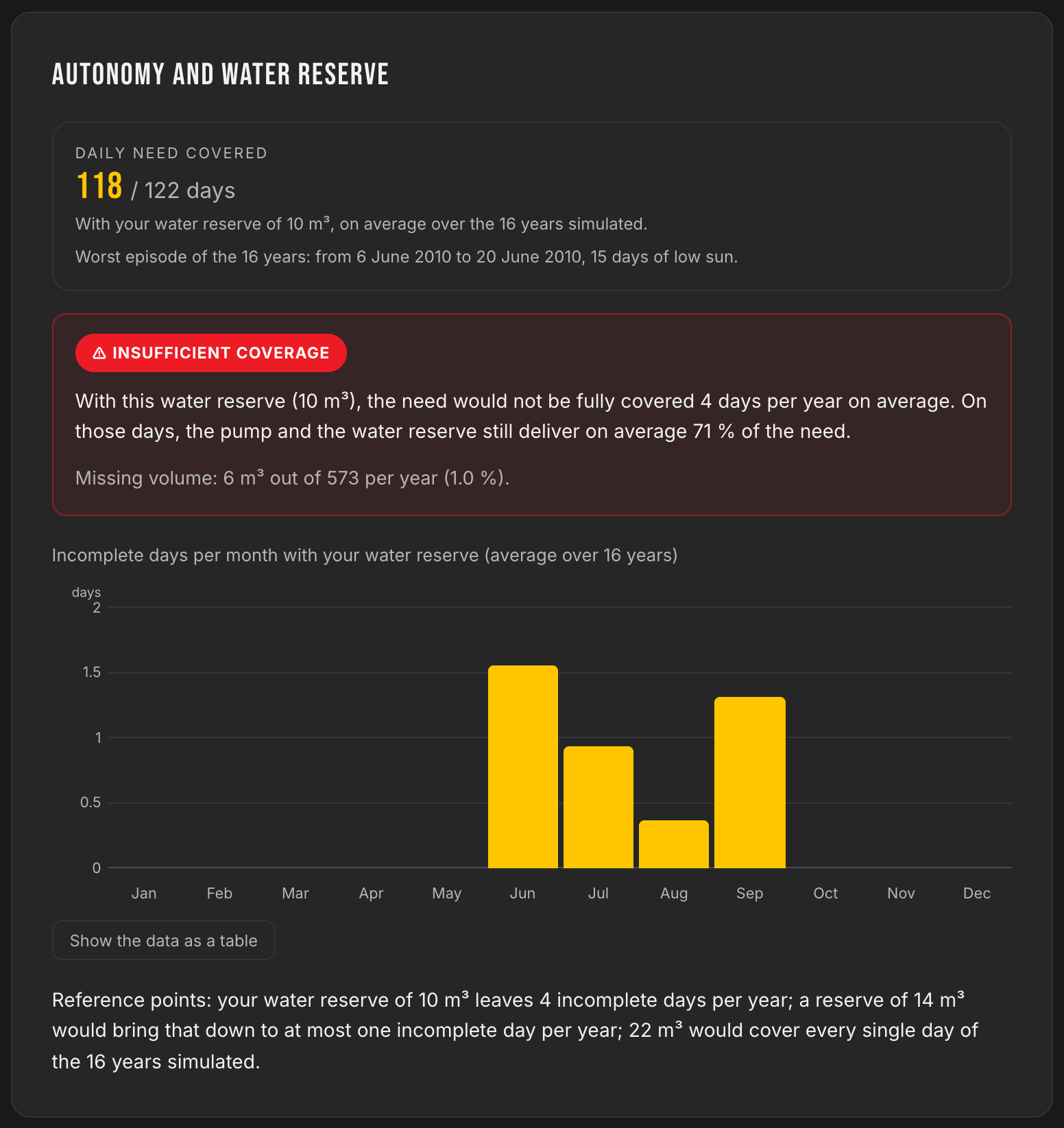
The benchmarks quantify the next step: 14 m³ would bring incomplete days down to no more than one per season, 22 m³ would cover every day of the sixteen years. One more tank is enough, if the association aims for zero hauling.
Manufacturer curves, at the real operating point
The pump's Q/H curves, plotted from official LORENTZ data, with the project's head highlighted: 0.6 m³/h at 51 m, at the pump's maximum, and LE LAB states it plainly. The AHR-04S accepts up to 0.8 m³/h and 60 m: the small rotor works at full capacity, and it is the 380 Wp array that was sized right at the edge.
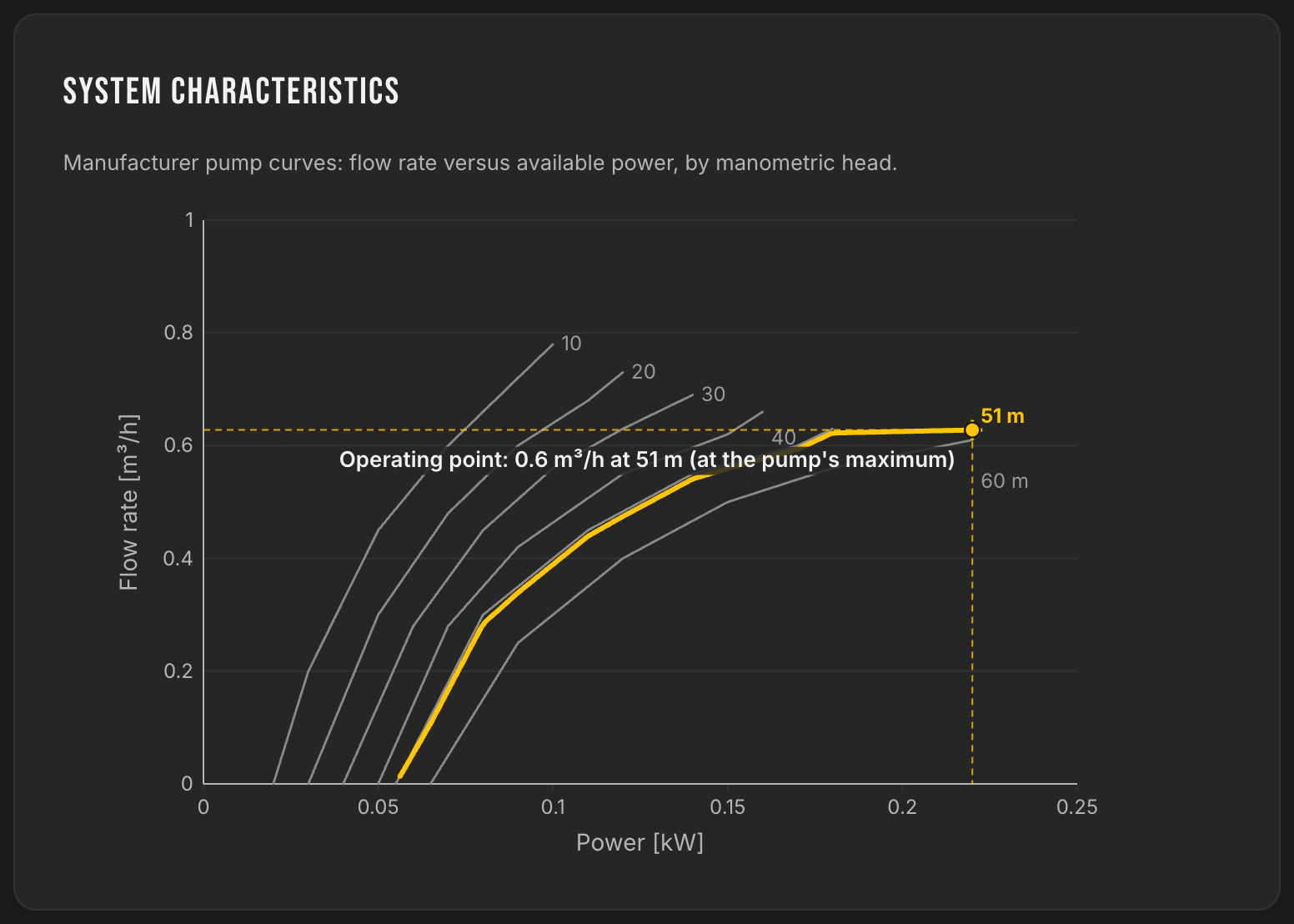
Flow according to available power, by head. The yellow curve is the project's, at 51 m.
The tool frames, the trade decides
Your project deserves the same study
Replay this study with your own figures: location, herd, spring or borehole. Free, no registration, results in a few minutes.