Grundfos SP or SPE:
which submersible pump for solar?
Both families share the same submersible hydraulics and the same RSI solar drive, but everything sets them apart on the motor side: the SPE carries an MS6000P permanent-magnet synchronous motor driven up to 100 Hz, the SP an MMS asynchronous motor built for 50 Hz. That difference governs efficiency, cut-in threshold, the size of the photovoltaic array and the operating domain of each family.
One solar drive, the same string rules
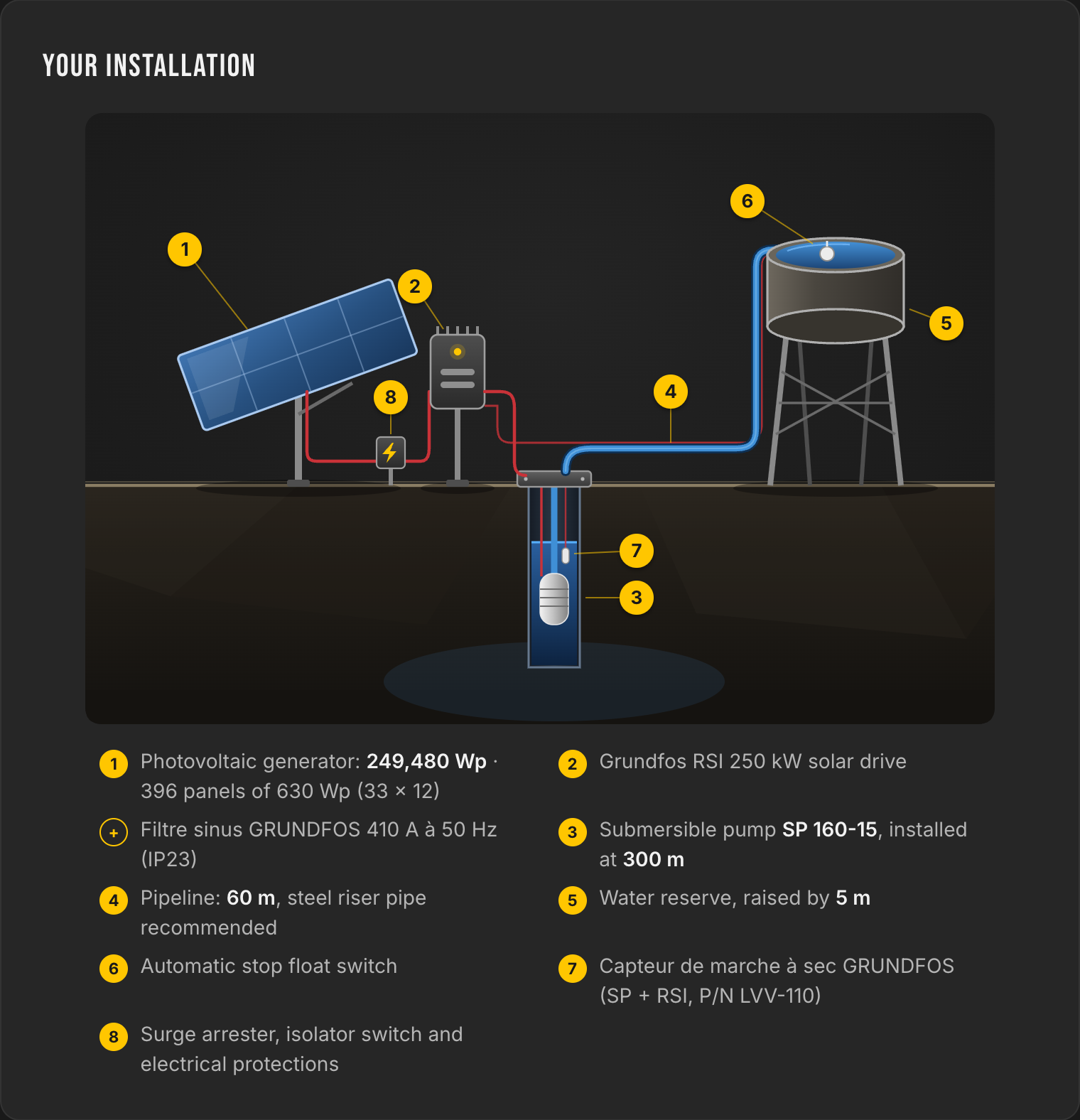
SP and SPE are both driven by the Grundfos RSI solar converter: built-in MPPT, a 450 to 800 V DC window in the high-voltage version, and a size selected on motor current, never on power alone. The photovoltaic string rules are identical for both families: string voltage above the MPPT threshold with hot cells, open-circuit voltage below 800 V with cold cells. Two accessories are mandatory whatever the family: the sine-wave filter between drive and motor, and the external Pt100 or Pt1000 temperature sensor, as the Tempcon sensor built into the motor is permanently disabled once the pump is fed by a drive.
Permanent magnets versus asynchronous: what really changes
The SPE was born for the drive: its MS6000P motor runs up to 100 Hz, twice the speed of a 50 Hz motor, which extracts more hydraulics from the same pump end, and its magnet rotor draws no magnetising current. The SP is Grundfos' universal submersible pump: its MMS asynchronous motor is built for the 50 Hz grid, and the RSI drives it between 30 Hz, the floor imposed by the manufacturer for motor warranty, and 50 Hz, with no overspeed. In return, the asynchronous motor pays for its magnetising current and rotor losses: at equal flow it draws more, and it starts later in the day.
| SPE (MS6000P) | SP (MMS) | |
|---|---|---|
| Motor technology | permanent-magnet synchronous | asynchronous squirrel-cage |
| Solar drive frequency | up to 100 Hz | 30 to 50 Hz |
| Overspeed | it is the rated duty | forbidden (locked at 50 Hz) |
| Motor powers in the LE LAB catalogue | up to 37 kW | 45 to 220 kW |
| Motor voltage | 3 × 350 V | 3 × 380-415 V |
| Sine-wave filter | mandatory in solar | mandatory, no exception |
| Filter selection | 100 Hz column of the current rating | 50 Hz column of the current rating |
| External temperature sensor | mandatory | mandatory |
| Dry-running protection | LVV-110 sensor | LVV-110 sensor |
SP 46-9 versus SPE 46-9: same hydraulics, two motors
Grundfos publishes both versions of the same pump: the 46-9 pump end exists as an asynchronous SP and as a permanent-magnet SPE. It is the cleanest possible comparison, since only the motor changes. At 75 m of head the gap is constant across the whole range: at equal flow, the asynchronous motor draws 9 to 11 % more power, and at full power it stops at 47 m³/h where the permanent magnets deliver 52. On a solar installation that gap is paid in panels: it is what grounds the priority LE LAB gives to the SPE whenever both families can answer.
Who serves what: small and medium duties on SPE, heavy duty on SP
In practice the two families barely overlap. The SPE covers small and medium duties with its higher efficiency; the SP takes over where permanent-magnet motors stop, with asynchronous motors from 45 to 220 kW carrying big flows at depth: 200 m³/h beyond 400 m of head, a zone no other solar range in the catalogue reaches. The shared ceiling is set by the drive: beyond 460 A of motor current there is no RSI left.
Sizing SP and SPE
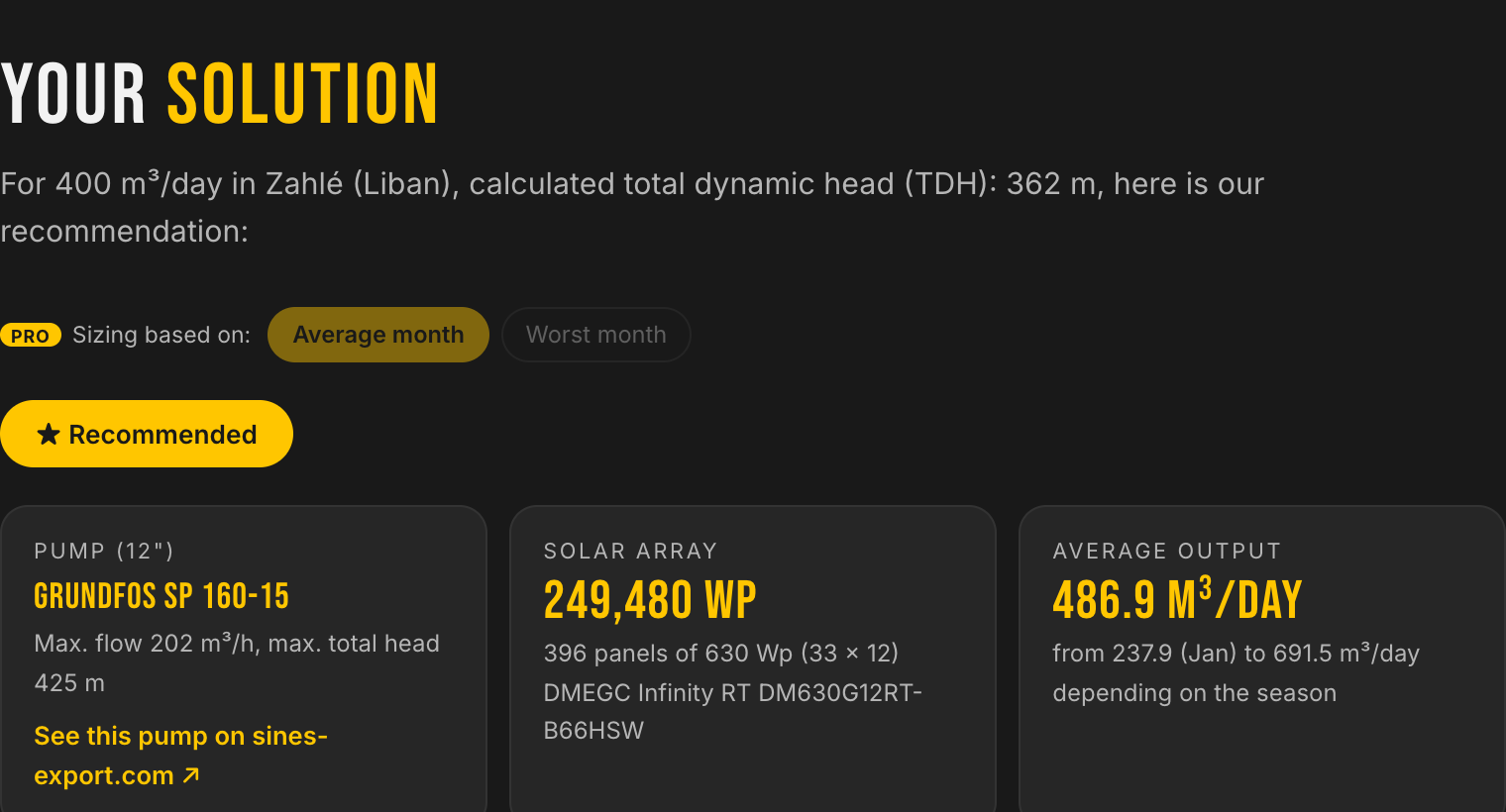
LE LAB embeds the manufacturer curves of both families and applies the rules specific to externally-driven pumps: the displayed cut-in threshold (the minimum power at the drive for the pump to deliver, derived from the shut-off head), a minimum continuous flow of 10 % of nominal flow for motor cooling, the family's frequency lock, and an automatic one-size drive upgrade on sites whose hottest month exceeds 42 °C when the current margin does not cover thermal derating. The study below, 400 m³/day at 300 m depth in Lebanon, returns an SP 160-15 with its 250 kW RSI: no other solar range answers this duty point.