A 300 m borehole with grid backup:
the arbitration in the Alentejo
In southern Portugal, an Alentejo farm draws from a deep aquifer: the water is 300 m down, the need is 60 m³ a day, and the tank already exists. The grid reaches the substation, and the farmer wants it as backup, because he knows winter will not make the 60 m³ on sunlight alone. That requirement changes everything: it takes the only truly hybrid range in the catalogue out of the running, and it sets two very different ways of bringing alternating current into a solar pump against each other.
When depth commands everything
Sixty cubic metres a day is a modest need. Three hundred metres of depth is another matter: with the lift and the friction losses, LE LAB computes 319 m of total dynamic head. At that head, the energy needed for the same cubic metre is more than twice that of a 120 m borehole, and the catalogue narrows fast.
The input data
The irradiation reference city is Beja, in the heart of the Alentejo. Depth 300 m, lift 5 m, 120 m of pipe, existing tank, and the backup power box on yes. It is that last answer which will tip the arbitration.
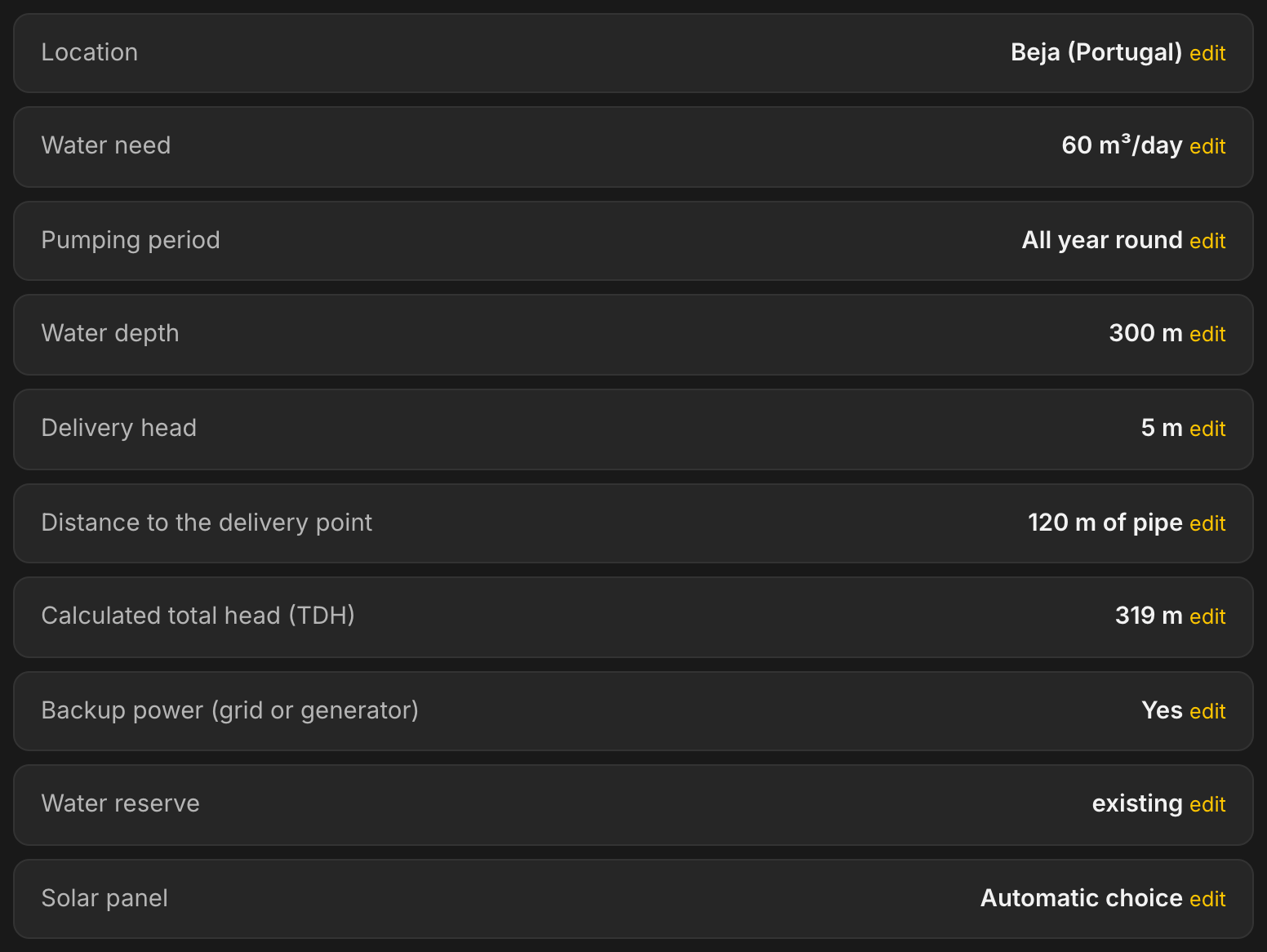
The summary before calculation, with the grid backup requested and the tank already in place.
The selected solution: a permanent-magnet motor on a drive
LE LAB selects a GRUNDFOS SPE 18-35, a 7.1-inch pump with a permanent-magnet synchronous motor, driven by a 37 kW RSI solar drive. It accepts 24 m³/h and 350 m of head, so it works at 319 m without being at its ceiling. The array counts 44 panels of 630 Wp, that is 27 720 Wp, wired as four parallel strings of eleven panels in series. Average production settles at 67.6 m³ a day.
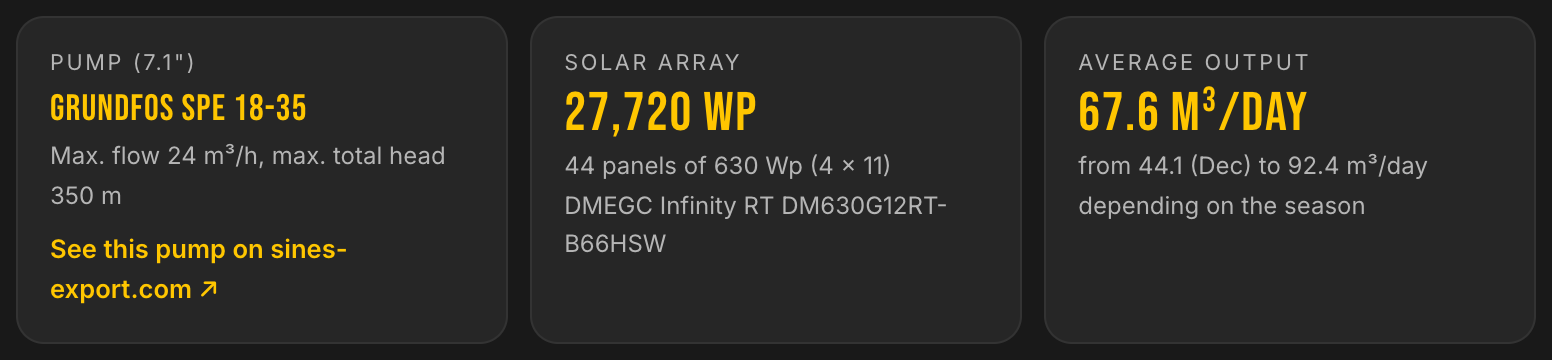
The solution at a glance. The seasonal range is stated: from 44.1 m³ a day in December to 92.4 in August.
What depth does to the catalogue
At 319 m of head the selection tightens abruptly. The LORENTZ PSk3 range, the only natively hybrid one in the catalogue, tops out at 180 m: it does not reach down here. The PSk2 does, but with the pump end that climbs highest in its range, a C-SJ30-35 whose maximum head is 330 m, and it then needs a considerably larger array. The asynchronous SP reaches it too, widely oversized for a 60 m³ need. That leaves the SPE, whose range goes up to 450 m and which finds its natural ground here.
| Solution | Photovoltaic array | Average production | Alternating-current input |
|---|---|---|---|
| GRUNDFOS SPE 18-35 + RSI 37 kW | 27 720 Wp · 44 × 630 Wp | 67.6 m³/d | drive terminals, with source changeover |
| LORENTZ PSk2-40 C-SJ30-35 | 48 925 Wp · 95 × 515 Wp | 73.6 m³/d | SmartPSUk2 converter to be added |
| GRUNDFOS SP 77-20 + RSI 110 kW | 84 150 Wp · 187 × 450 Wp | 99.7 m³/d | drive terminals, with source changeover |
| LORENTZ PSk3 | out of reach: the range stops at 180 m of head | ||
The PSk2 demands 48 925 Wp where the SPE asks for 27 720, that is 95 panels instead of 44. This is no longer a matter of appreciation, it is a difference in kind: at that head the LORENTZ pump end works at the top of its range while the SPE stays within its efficiency band.
Why backup is not a comfort here
Production runs from 44.1 m³ a day in December to 92.4 in August. The summer months go well beyond the need, but December, January and November fall below. On a deep borehole, winter cannot be caught up by reasonably enlarging the array: you would have to size on the least favourable month and pay all year for an array calibrated for December. The farmer chose the other route, keeping a right-sized array and letting the grid make up the grey weeks. That is exactly the role of backup.
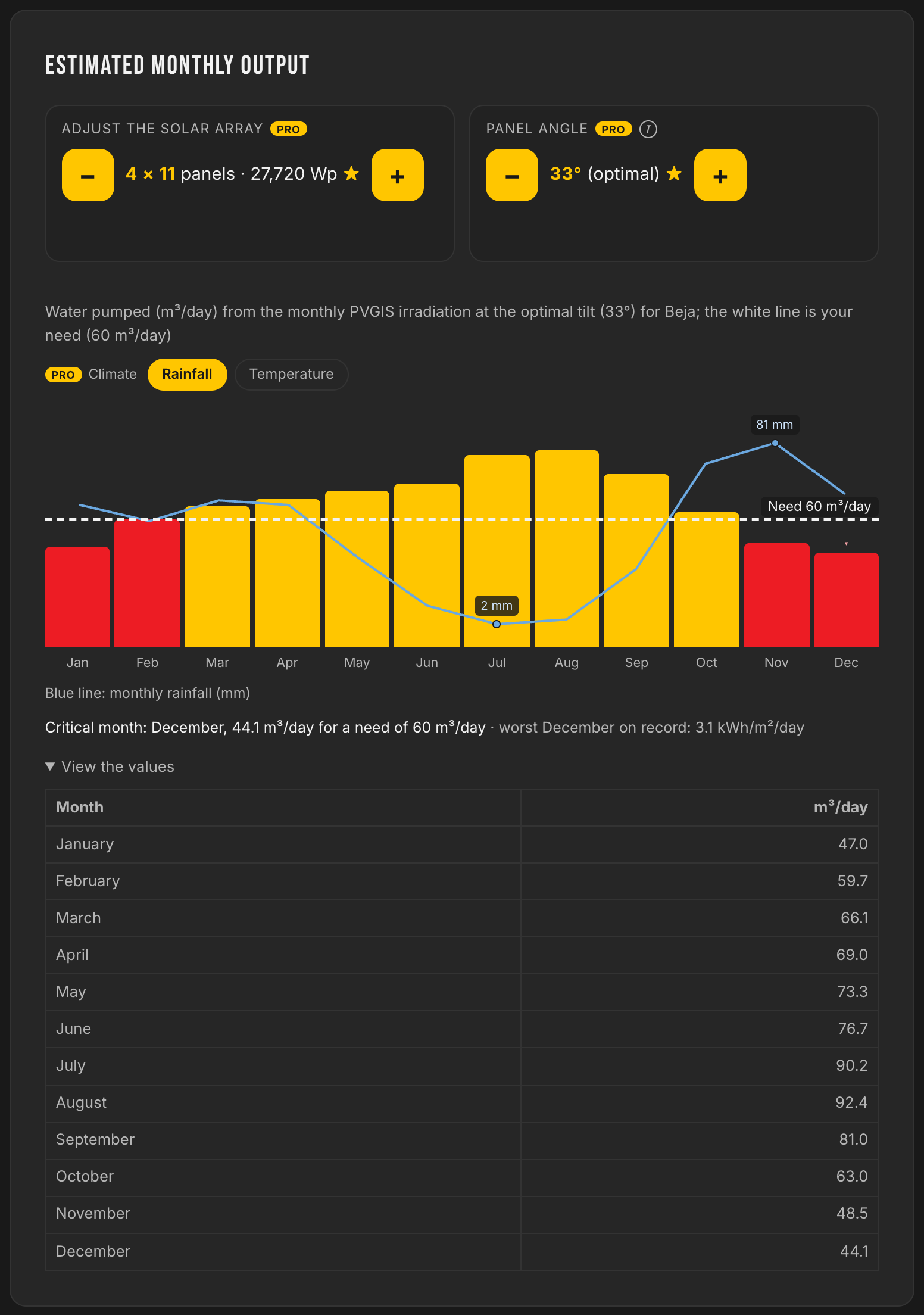
Three months fall below the line of the need. That is where, and only there, the grid takes over.
Three ways of bringing alternating current into a solar pump
The word backup covers three very different architectures, and the solar catalogue offers all three. Telling them apart is the real technical subject of this file.
Here the hybrid range does not go down to 319 m, and the separate-converter architecture imposes 95 panels instead of 44. The SPE on an RSI drive therefore wins on the photovoltaic array, and its alternating-current input connects without a converter, a source changeover being enough. On a shallower borehole and with no backup requested, the ranking reverses, as this Andalusian orchard shows, where the integrated controller comes first.
What the drive imposes around it
A submersible motor driven by a drive is not wired like an integrated controller. The diagram generated by the study carries the mandatory items of this architecture: the sine-wave filter between drive and motor, and the dry-running sensor. On this range, the motor's internal temperature sensor is disabled as soon as the pump is fed by a drive, and an external probe takes over.
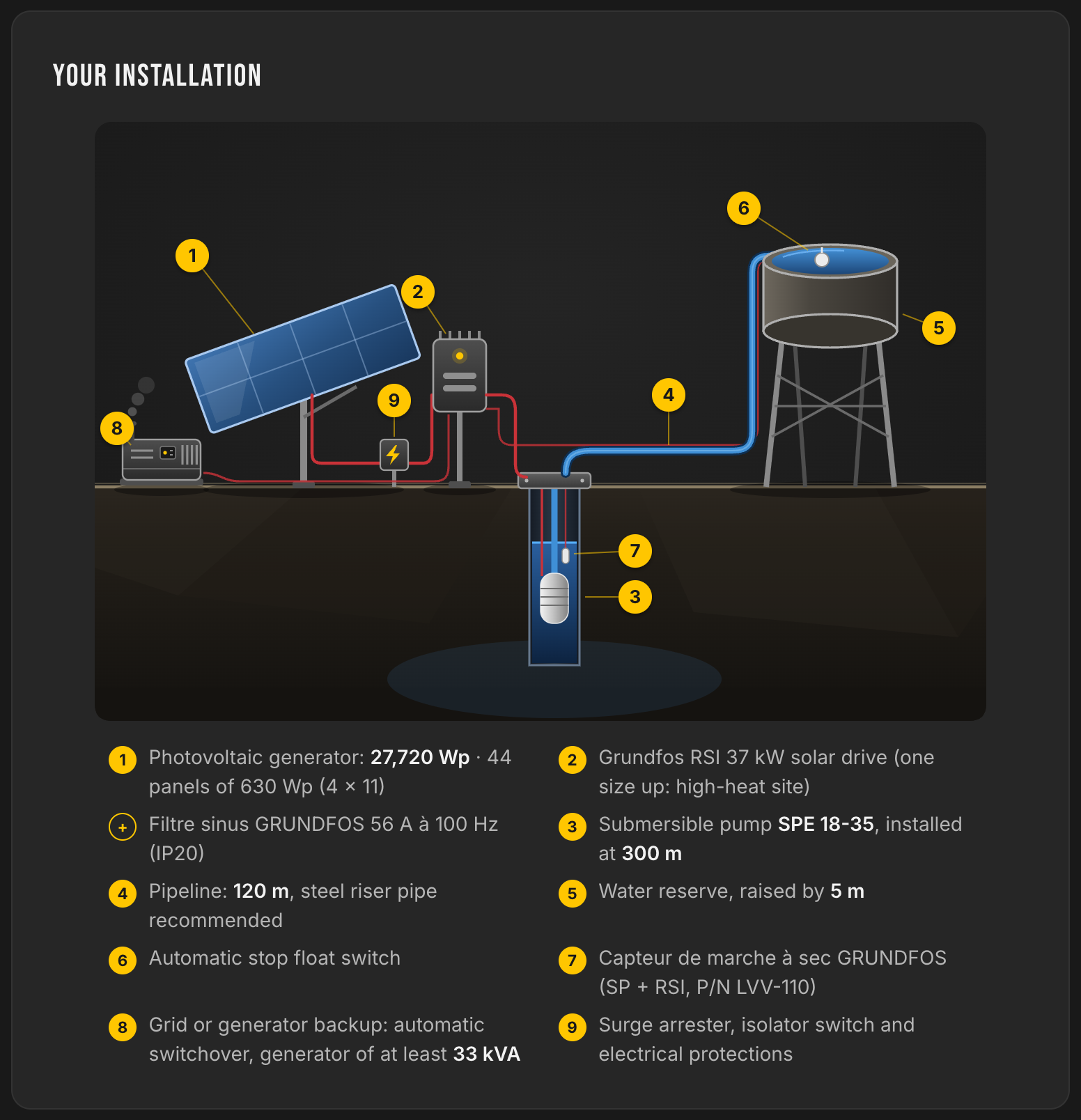
The installation diagram generated by the study, with the items proper to a pump on a drive.
Depth chooses the family, backup chooses the architecture
Your project deserves the same study
Replay this study with your own figures: location, need, borehole, backup power. Free, no registration, results in a few minutes.