Integrated controller or solar drive:
250 m³/day in Andalusia
In the Guadalquivir valley, a drip-irrigated orchard draws its water from a 120 m borehole and fills a raised pond. Peak demand is 250 m³ a day, there is no power line on the plot and the grower does not want one. Three pump families can hold this duty point: a LORENTZ PSk2 controller, a GRUNDFOS SPE permanent-magnet motor on an RSI drive, and a GRUNDFOS SP asynchronous pump on the same drive. Here is how LE LAB separates them, and why one drive feature, real as it is, counts for nothing here.
An orchard, a pond, not a power socket
The layout is that of thousands of Andalusian plots: a borehole, a pipe rising to an irrigation pond, and drip lines fed by gravity from the pond. The pump therefore does not have to follow the emitters' demand, it has a single duty, filling the pond within the day. A grid connection is not considered: the substation is far away, and solar at the pace of the sun suits this kind of filling exactly.
The input data
Seven answers are enough. The irradiation reference city is Córdoba, water depth 120 m, lift to the pond 5 m, pipe run 150 m. LE LAB computes the total dynamic head on its own, 132 m, adding friction losses to the elevation. The backup power box stays on no, and that answer counts as much as the others.
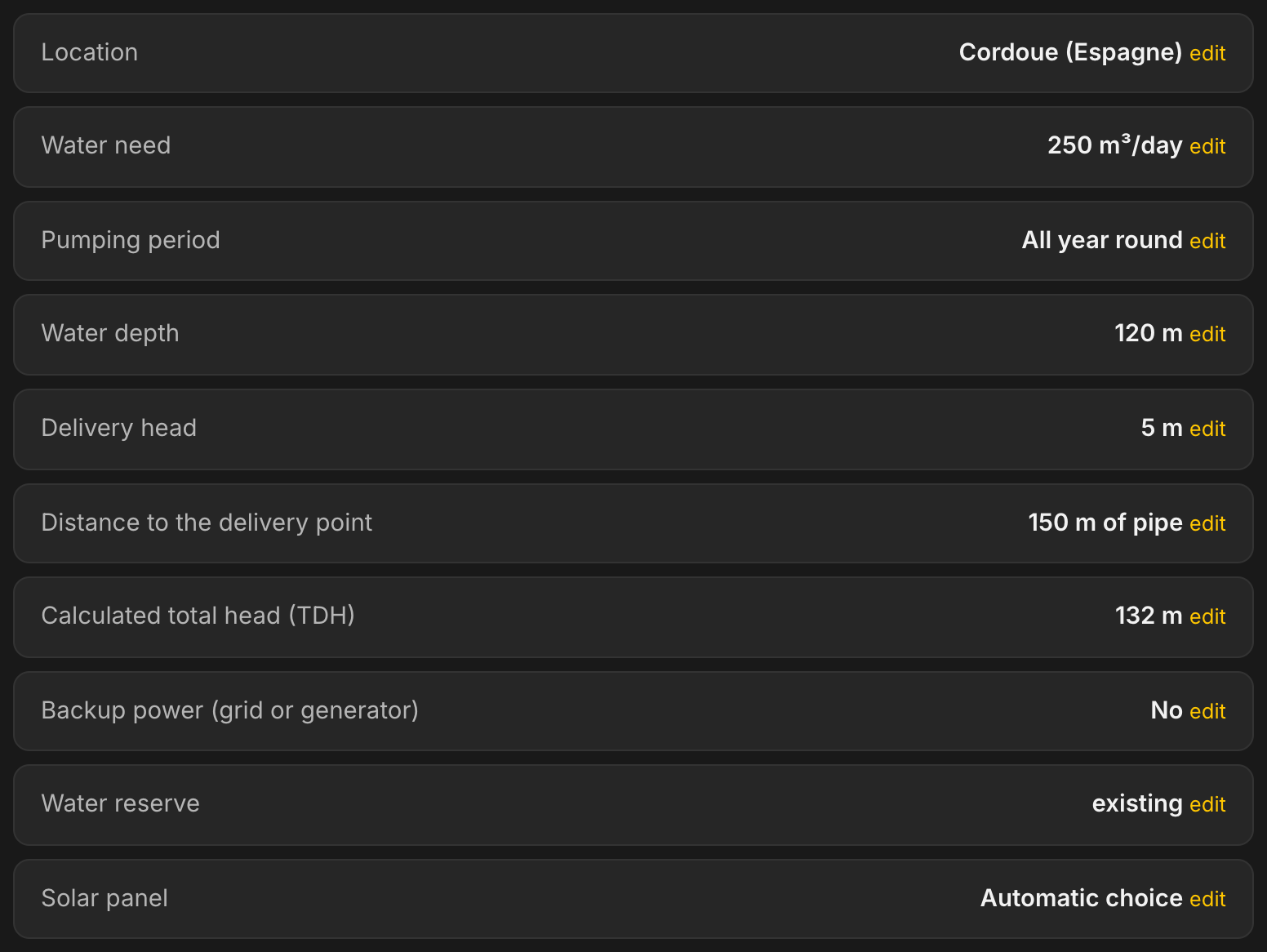
The summary before calculation. The total dynamic head is computed for you, it is not to be entered.
The selected solution: an integrated controller
LE LAB selects a LORENTZ PSk2-40 fitted with the C-SJ42-19 pump end, a 6-inch assembly accepting up to 63 m³/h and 200 m of head. The array counts 48 panels of 630 Wp, that is 30 240 Wp, wired as three parallel strings of sixteen panels in series. Average production settles at 281.7 m³ a day for 250 required.
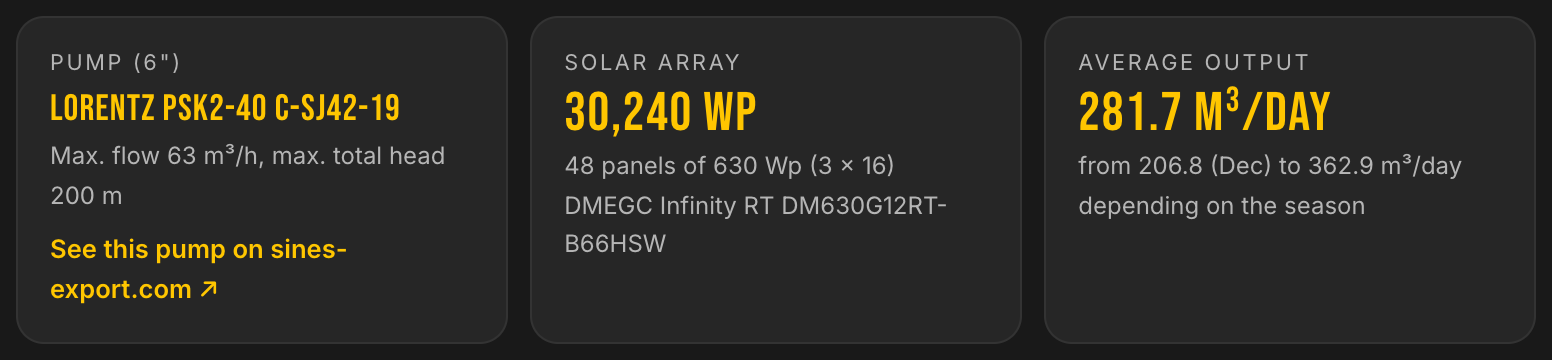
The solution at a glance: the pump, the array and the average production, with the seasonal range stated without fuss.
The three families at the same duty point
LE LAB does not show a single answer. At 250 m³ a day and 132 m of head, three families hold the need, and they rank by the size of the photovoltaic array they demand. That is where the gap opens.
| Solution | Photovoltaic array | Average production | Equipment |
|---|---|---|---|
| LORENTZ PSk2-40 C-SJ42-19 | 30 240 Wp · 48 × 630 Wp | 281.7 m³/d | integrated PSk2-40 controller |
| GRUNDFOS SPE 32-23 | 35 280 Wp · 72 × 490 Wp | 276.4 m³/d | RSI 37 kW drive, sine-wave filter, temperature sensor |
| GRUNDFOS SP 77-15 | 46 350 Wp · 90 × 515 Wp | 283.3 m³/d | RSI 110 kW drive, sine-wave filter, temperature sensor |
The SPE demands 17 % more panels than the PSk2, the asynchronous SP 53 % more. The gap between the two Grundfos is no surprise, it is the motor's: the asynchronous SP against the permanent-magnet SPE, at comparable hydraulics, draws more at equal flow. The gap with the PSk2 comes both from the chain efficiency and from the fact that LE LAB picks, in each family, the most frugal pump that holds the need.
Production, month by month
On the real irradiation of the region, production runs from 206.8 m³ a day in December to 362.9 in July. Sizing is done on the average month, and the range is shown as it is: the winter months fall below the 250 m³ required. For an orchard that is the right trade-off, since peak irrigation falls precisely when the sun is there. A grower who needed the 250 m³ in December would read this chart and size on the least favourable month, which the application offers.
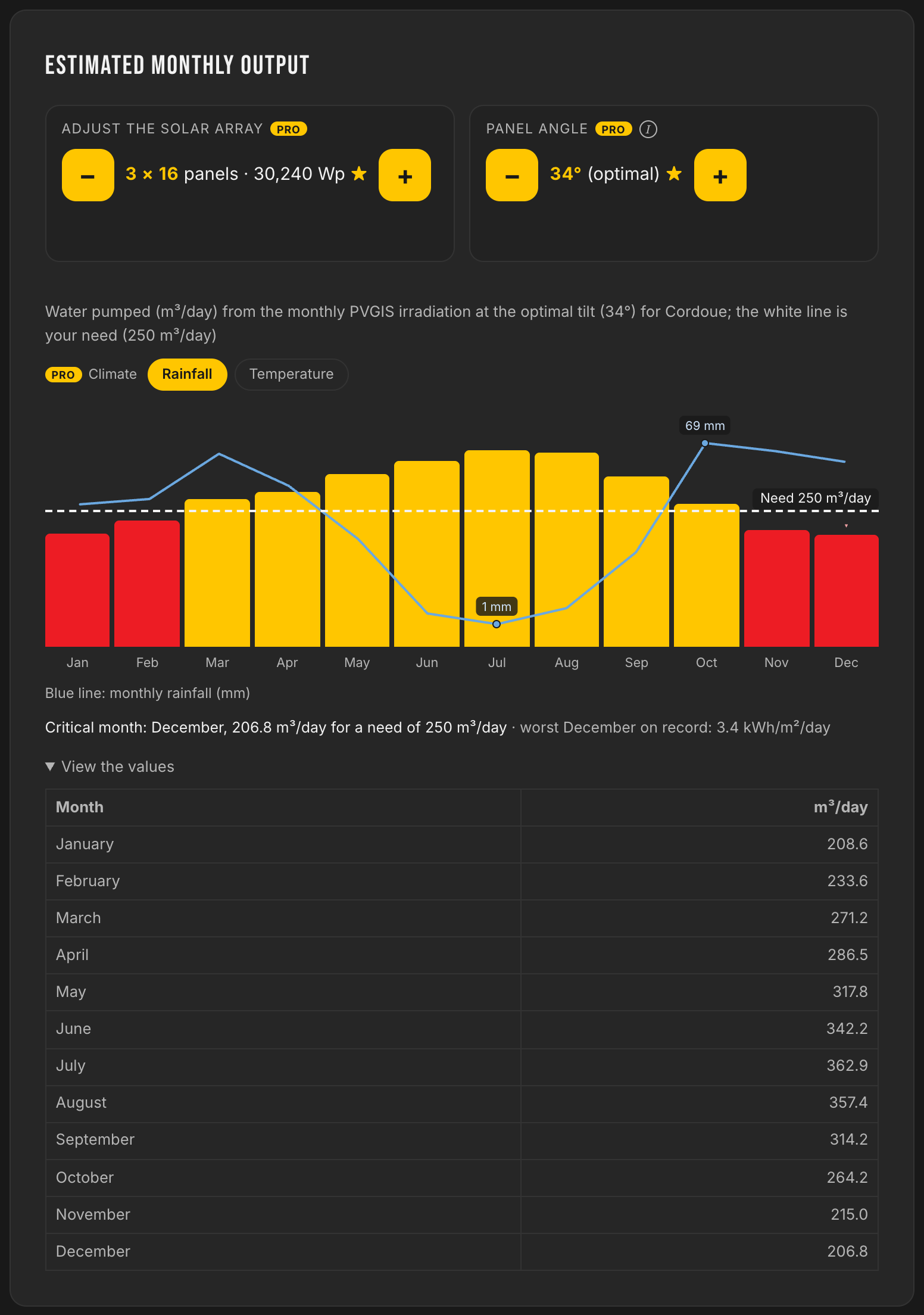
Estimated monthly production, against the line of the need. The blue curve is rainfall, it tells the irrigation season better than a calendar.
The RSI alternating-current input, and why it counts for nothing here
The GRUNDFOS RSI solar drive has a feature the PSk2 controller does not have as standard: it accepts alternating current. The photovoltaic array and a three-phase supply connect to the same drive input terminals, through a source changeover that prevents them from being connected at the same time, and the manufacturer presents this supply as a backup in case the solar array is interrupted. It is a real advantage, provided you need it.
On this orchard nobody does. The criterion therefore separates nothing, and the ranking is played on the only thing that costs panels and ground space, the size of the array. That is how the integrated controller wins, even though the drive offers one possibility more. In a country next door, on a far deeper borehole and with the grid at the substation, the same question gives the opposite answer, and for good reasons.
Array size decides, the alternating-current input does not weigh
Your project deserves the same study
Replay this study with your own figures: location, need, borehole, backup power. Free, no registration, results in a few minutes.